

Large Language Models (LLMs) aren’t just a tech buzzword anymore — they’re quietly reshaping how people discover information and make purchase decisions. If Google Search was the map, LLMs are the tour guide — answering questions directly, recommending products, and leaving traditional search results in the background.
LLM Rankings are your brand’s visibility inside these AI-generated answers. If you’re not tracking them, you could already be losing ground to competitors — without even knowing it.
What Are LLM Rankings?
Think of LLM rankings as “SEO for AI assistants.”
Instead of competing for position on a Google search results page, you’re competing for inclusion in the answers given by AI tools like ChatGPT, Gemini, Claude, and Perplexity.
Example:
- Google search: You type “best CRM for small business” and see a list of websites ranked by SEO.
- ChatGPT: You ask “What’s the best CRM for small business?” and it replies with a short list of tools — maybe Salesforce, HubSpot, Zoho — and reasons why.
If your brand isn’t in that answer, you’ve just lost a highly qualified lead to whoever is.
Should You Care?
Yes. And here’s why:
- LLMs are becoming the first stop for research. Increasingly, people go to AI chat instead of a search engine.
- LLM answers often skip links altogether. They summarize results, so if your brand isn’t named, you don’t even get the click.
- High intent = high value. People asking AI for recommendations are often closer to making a purchase — similar to how long-tail SEO keywords convert better.
Ignoring LLM rankings now is like ignoring SEO in 2005. You can, but you’ll regret it.
The Platforms That Matter
There are dozens of AI models, but the “Big Four” currently dominate consumer and business use:
- OpenAI (ChatGPT) – Market leader in general-purpose AI.
- Google Gemini – Deep integration with Google’s ecosystem and search data, and now powering AI Overviews in Google’s SERPs.
- Anthropic Claude – Known for concise, context-rich answers.
- Perplexity – Hybrid between AI chat and a search engine, often citing live web sources.
Although OpenAI is the most prominent, and Google Gemini has a huge advantage through its SERP integration, you can’t ignore Claude and Perplexity. What’s happening today is that people have options. And with options come preferences.
Because you can’t assume your audience’s AI tool of choice, you need to check them all. Better early than sorry, as we say. It’s like walking into a restaurant when most tables are empty — you can choose any one you want, and your choice might not be the same as the next customer’s. Back in the day, it was Google and… nothing else. Now, the landscape is wide open.
The LLMs Models
LLMs evolve quickly, and only the most current models available via API give you an accurate, actionable snapshot of how your brand performs in real-world AI visibility. Here’s the latest lineup:
OpenAI (ChatGPT)
- GPT‑5 – Released August 7, 2025, now available via the OpenAI API (alongside GPT‑5‑mini and GPT‑5‑nano)
- Deprecated: Older models like GPT‑4o, GPT‑4.1, o3, and their variants have been retired from consumer apps; in the API context, GPT‑5 is now the default for most use cases
Google Gemini
- Gemini 2.5 Pro – High-reasoning and coding model with “Deep Think” mode, accessible via API and Vertex AI
- Gemini 2.5 Flash and Flash‑Lite – Built for speed and cost-efficiency; available via API and app interfaces
- gemini‑embedding‑001 – Embeddings model accessible via API for developers
- Veo 3 (Video + Audio) – Available in paid preview via API and Vertex AI
Anthropic Claude
- Claude Opus 4.1 – Released August 5, 2025; API-accessible and available across Claude API, Amazon Bedrock, and Vertex AI
- Claude Sonnet 4 – Also API-accessible; now supports up to 1 million tokens of context in beta
- Deprecated: Claude Sonnet 3.5 models are being phased out and will be retired by October 22, 2025
Perplexity
- While Perplexity doesn’t publish specific model names via API, their Max tier gives access to best-in-class API models—like OpenAI’s o3‑pro or Claude Opus 4—alongside their own hybrids that mix AI and live web citation. This access is tier-dependent
Why API Access Matters
- Real Results, Real Users: API-accessible models are what developers and products use—so testing them mirrors actual user experience.
- Versioned Accuracy: You get the latest flavor—test with GPT-5, not outdated GPT-4 variants; similarly, try Gemini 2.5 Pro or Flash via API.
- Visibility Across Platforms: Consistency in tracking across OpenAI, Google Gemini, Claude, and Perplexity ensures you’re not drawing conclusions from outdated tools.
The Process (Step-by-Step)
Right now, there’s no “LLM Search Console”. Tracking requires a manual (or automated via a tool) process:
- Create realistic prompts – These should match what your potential customers actually ask. Example:
- “Best CRM for freelancers”
- “Top eco-friendly shoe brands”
- “Alternatives to [Competitor Name]”
- Test them across all major platforms – Run the same prompts in ChatGPT, Gemini, Claude, and Perplexity.
- Record results – Note every brand mentioned, the order, and any links or references.
- Repeat – Track changes over time to see trends
The prompts
Your LLM ranking results are only as good as the prompts you test. If you ask the wrong questions, you’ll get the wrong picture of your brand’s visibility.
How people search is shaped by:
- Geography – A founder in the UK might search differently from a founder in the US.
- Persona – A marketer, a small business owner, and a VC investor have completely different vocabularies and priorities.
- Target keywords – The terms you’re actively trying to rank for.
- Keyword opportunities – High-value terms you’ve identified but haven’t targeted yet.
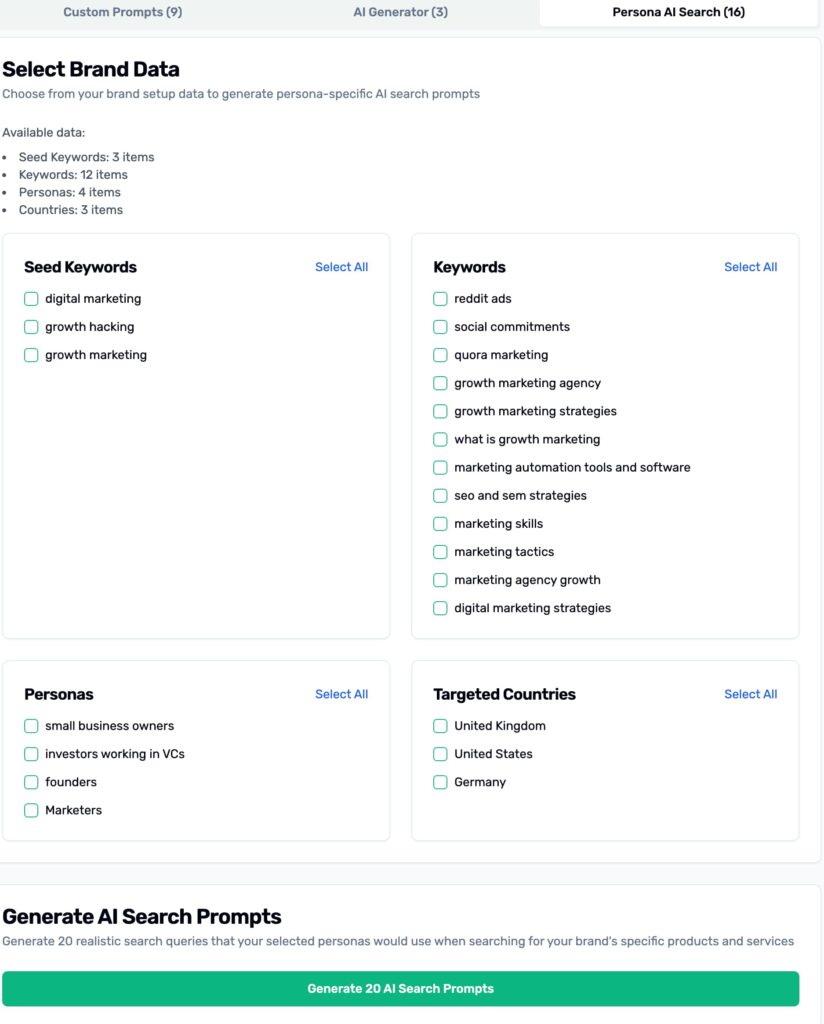
That’s why the first step in LLM rankings is building a prompt set that covers all of these angles.
In practice, that might mean:
- Pulling your seed keywords (e.g., “growth marketing,” “digital marketing”).
- Adding specific keyword opportunities (e.g., “quora marketing,” “marketing automation tools”).
- Layering in persona-specific context (“As a small business owner in the UK…”) so you get results that reflect how your real customers search.
- Including country targeting when relevant, because AI results often shift subtly based on geography.
Pro tip:
Some prompts should be monitored even if you think “no one would search for that.” Why? Because they may still appear in AI-generated recommendations due to related terms, competitor mentions, or niche contexts. Ignoring them means missing hidden mentions — or missing the early warning that you’re being edged out.
Analysing the Results
Don’t just look for your name. Break it down into:
- Direct mentions – Does your brand appear?
- Named competitors – Who else is getting the recommendation?
- Unexpected competitors – Are you competing with brands you didn’t even consider?
- Links & sources – Are the AI models citing websites, and are they yours?
- Sentiment – Is your brand mentioned positively, neutrally, or negatively?
Sentiment matters. Being “included” is good, but being described as “too expensive” is a problem you can fix.
Is It 100% Accurate?
No. LLMs can produce slightly different answers every time due to randomness in generation. But if you see a consistent pattern (e.g., your competitor appearing in 8 out of 10 runs), you can be confident it’s not random.
How Often Should You Run It?
- Initial phase: Daily for the first 1–2 weeks to establish a baseline.
- Ongoing: Weekly monitoring is enough for most brands.
- Special cases: Run it immediately after major events — like a product launch, PR campaign, or a Google AI update — to see if you’re being picked up.
Is There a Cost?
Yes, the feed and the process cost. In three main ways:
- AI API credits – Each query to GPT-4, Gemini, Claude, or Perplexity costs usage credits.
- Time – Prompt creation, testing, and result analysis can be time-intensive.
- Analysis tools – Some platforms (like GrowthOS) automate the process but have subscription fees.
Let’s do some quick mathematics:
- 40 prompts (a very small set — enough for just 1–2 personas)
- 4 engines (OpenAI, Gemini, Claude, Perplexity)
- Daily execution for 30 days:
- 40 × 4 × 30 = 4,800 prompt runs per month
- Weekly execution for 4 weeks:
- 40 × 4 × 4 = 640 prompt runs per month
That’s just the raw query volume — it doesn’t even factor in the cost of storing results, running sentiment analysis, or manual review time.
How Much Traffic Comes from LLMs?
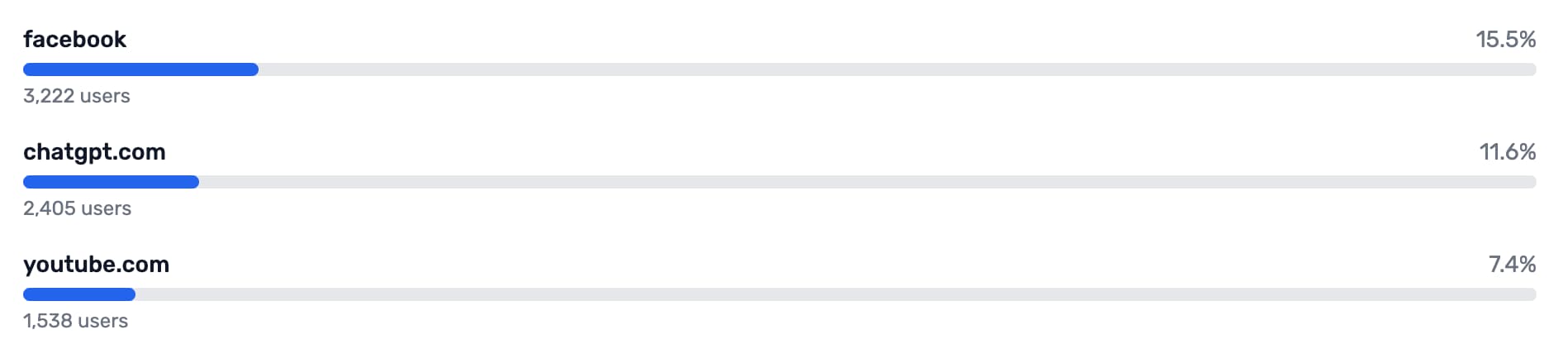
Right now, LLM-driven traffic can be 10–13% of your total inbound visits — but the real value is intent quality.
Like long-tail SEO keywords, AI-driven recommendations tend to convert better because the user has already expressed a specific need.
Example:
- A search for “what is a CRM” is low intent.
- A question to ChatGPT for “best CRM for solo consultants” is high intent — and more likely to end in a purchase.
Tools for LLM Ranking Monitoring
Manually doing this is possible but slow. Tools are emerging to help:
- Ahref, Moz and Semrush came up with these additions in their platforms.
- GrowthOS by GrowthHackers – Automated prompt testing, tracking across all major LLMs, brand and competitor analysis.
- Seonali – AI-focused search & brand monitoring.
- scrunchai – a platform for understanding how your brand appears inside of generative AI platforms like ChatGPT, Gemini, Perplexity, and more.
Expect more specialized tools in the next 12 months as LLM optimization becomes a formal marketing discipline.
What Comes After the Analysis?
That’s the point. Tracking LLM rankings is only the first step. Once you have data, you can actively work to influence results:
- Content optimization – Publish high-authority articles on topics you want AI to recommend you for.
- Digital PR – Get featured in credible sources AI models already use.
- Partnerships – Collaborate with complementary brands to be co-mentioned.
- Structured data – Use schema markup to make your content easier for AI to understand.
- Reputation management – Address negative sentiment directly.
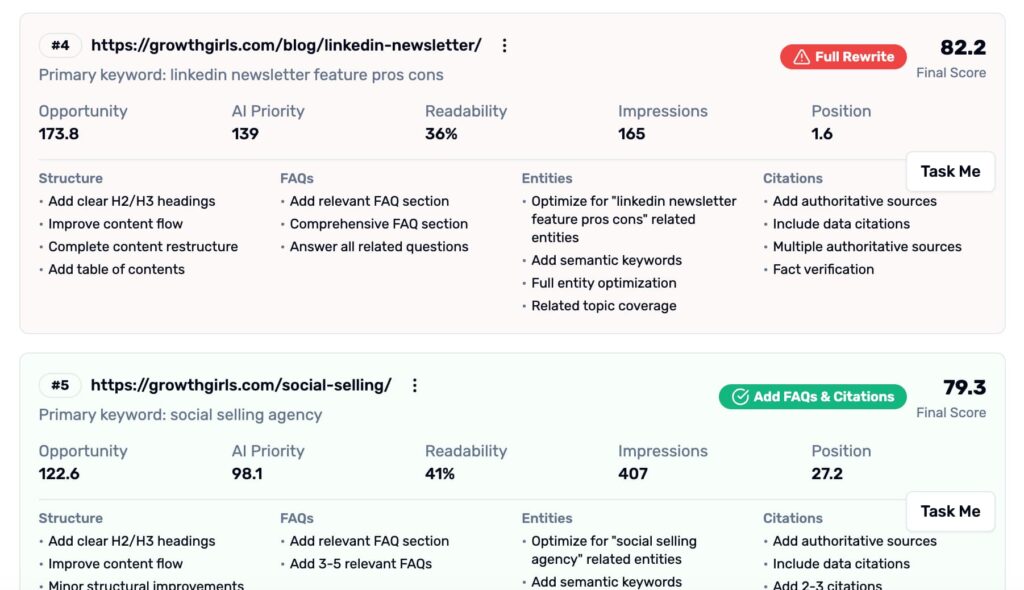
Think of it as moving from “SEO” to AIO — AI Optimization. In Growth OS we offer a full platform for your next step in ranking on LLMs. We invented our our mathematical formulas to decide what needs to be changed and what’s the modification needed.
Bottom Line
In the same way brands once had to learn how to rank in Google, the new frontier is learning how to rank in AI assistants. LLM rankings aren’t a tech fad — they’re the new battleground for visibility.
Brands who start tracking and optimizing now will own the conversation inside AI tools tomorrow. Those who don’t will one day wonder why they’ve vanished from their customers’ first point of contact.
